
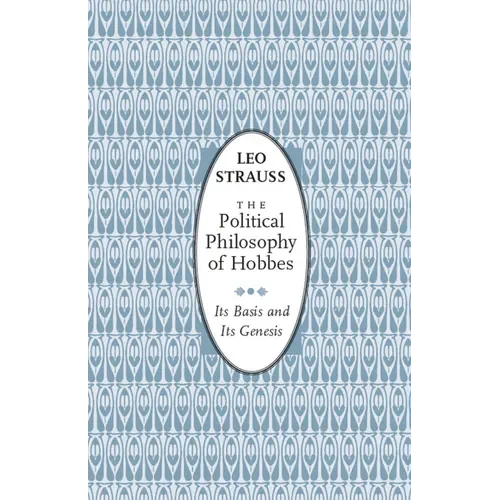
Description
Report copyright infringement
by
Leo Strauss (Author),
Elsa M. Sinclair (Translator)
In this classic analysis, Leo Strauss pinpoints what is original and innovative in the political philosophy of Thomas Hobbes. He argues that Hobbes’s ideas arose not from tradition or science but from his own deep knowledge and experience of human nature. Tracing the development of Hobbes’s moral doctrine from his early writings to his major work The Leviathan, Strauss explains contradictions in the body of Hobbes’s work and discovers startling connections between Hobbes and the thought of Plato, Thucydides, Aristotle, Descartes, Spinoza, and Hegel.
Back Jacket
In this classic analysis, Leo Strauss pinpoints what is original and innovative in the political philosophy of Thomas Hobbes. He argues that Hobbes’s ideas arose not from tradition or science but from his own deep knowledge and experience of human nature. Tracing the development of Hobbes’s moral doctrine from his early writings to his major work, The Leviathan, Strauss explains contradictions in the body of Hobbes’s work and discovers startling connections between Hobbes and the thought of Plato, Thucydides, Aristotle, Descartes, Spinoza, and Hegel.
Author Biography
Leo Strauss (1899-1973) was Robert Maynard Hutchins Distinguished Service Professor Emeritus in political science at the University of Chicago. Among his works published by the University of Chicago Press are Thoughts on Machiavelli, The City and Man, and Natural Right and History.
Number of Pages: 190Dimensions: 0.48 x 8.52 x 5.62 INPublication Date: April 15, 1996




Reviews
There are no reviews yet.